There Were Warnings
Our take
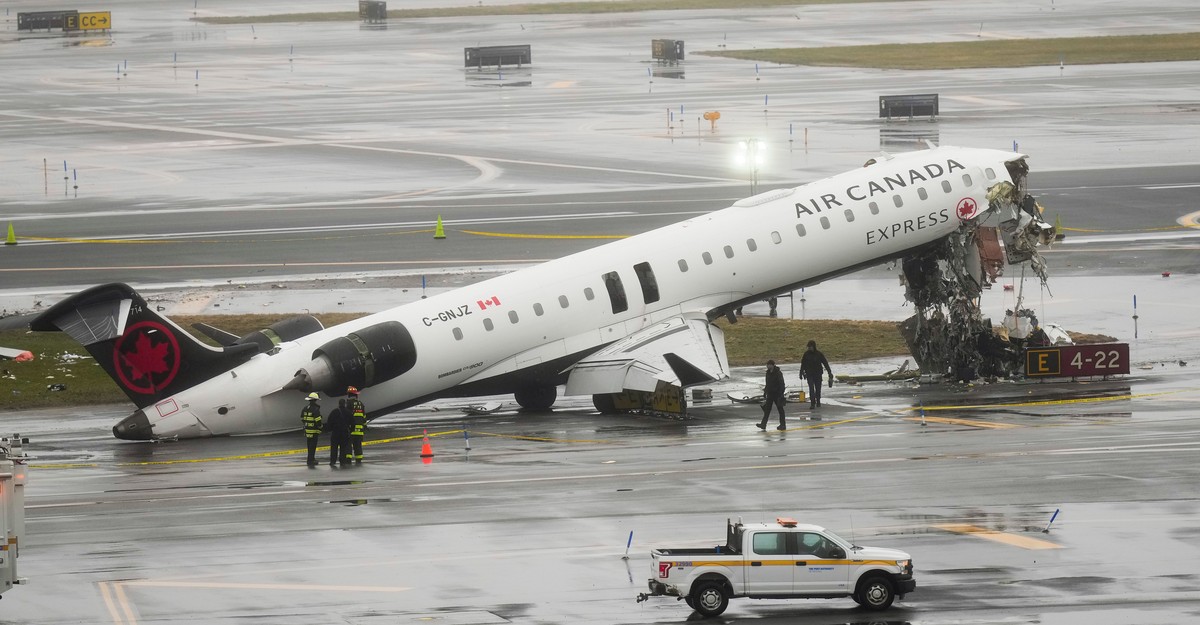
The recent announcement by President Trump to deploy ICE agents at airports in response to TSA worker shortages is emblematic of a larger governance crisis that neglects essential safety and operational needs. This decision comes on the heels of a tragic incident at LaGuardia Airport, where an Air Canada flight collided with a fire truck, resulting in fatalities and numerous injuries. These events are not isolated but interconnected, reflecting an alarming trend in air traffic safety that many have been warning about for years. As noted in the article “American Aviation Is Near Collapse,” the aviation system is increasingly strained, and near misses are becoming alarmingly common. The question we must ask ourselves is whether our leadership is truly equipped to address these pressing issues or if they are merely reactive to the crises that unfold.
Transportation Secretary Sean Duffy’s recent attempts to blame Democrats for the chaos at airports exemplify a dangerous diversion from accountability. While he insists that staffing cuts have not directly affected air traffic controllers, the reality is that the Federal Aviation Administration (FAA) has faced significant reductions in personnel. The tragic events at LaGuardia highlight that the air traffic control system is not functioning optimally; indeed, only one controller might have been on duty during the crash. This raises serious concerns about the current state of air traffic safety. When we consider the near-miss incidents, such as the close calls involving Alaska Airlines and FedEx flights, it's evident that these are not just anomalies but warnings that the system is reaching a breaking point.
Moreover, the deployment of ICE agents as a stopgap measure for airport security is likely to exacerbate rather than alleviate traveler concerns. As the article “Shockingly, ICE Hasn’t Fixed the Airport Crisis” points out, adding ICE into the equation does little to address the core issues at hand. Instead, it distracts from the necessary focus on reinforcing TSA operations and improving the overall security framework. The administration's approach seems to prioritize political maneuvering over the practical realities of public safety. This cavalier attitude toward contingency planning, as noted in discussions about everything from airport security to broader international issues, is troubling. The lack of foresight and preparation creates an environment where safety is compromised, and public trust is eroded.
As we move forward, it is crucial to consider the implications of these ongoing challenges. The erosion of effective governance not only endangers travelers but also reflects a broader disregard for the systems and people that ensure our safety and well-being. The question remains: how will our leadership adapt to these systemic failures? Will we see a shift towards genuinely addressing the underlying issues, or will we continue to witness a pattern of reactive governance that prioritizes optics over substance? This is a pivotal moment for our aviation system and public safety as a whole, and the answers to these questions will profoundly impact how we navigate the future.
In the coming weeks, it will be essential to monitor both the administration’s response to these crises and the public’s reaction. Are we prepared to demand accountability from those in power, or will we accept half-measures that fail to address the root causes of these systemic failures? The stakes are high, and our collective safety hangs in the balance.
On Saturday, President Trump announced plans to deploy ICE agents to help with security at airports across the country, given all of the TSA workers who are either quitting or not showing up because they haven’t been paid for weeks. Last night, an Air Canada airplane collided with a fire truck on a runway at New York’s LaGuardia Airport, killing two pilots and hospitalizing scores of passengers. These twin crises are separate but related: They are both the result of an approach to governance that neglects the work of governing.
Anyone with even a passing interest in air-traffic safety knows that near misses have grown more frequent. In the New York area, there have been two close calls this month alone: An Alaska Airlines Boeing 737 nearly collided with a FedEx Boeing 777 in Newark last Tuesday, and another Air Canada flight nearly hit an EVA Air 777 Boeing at John F. Kennedy International Airport on March 12. When a tragedy is averted, some presume that the system is working, a phenomenon in disaster management known as the “near-miss fallacy.” But many complex systems on the brink of failure leave clues, and near misses are flashing red lights.
Transportation Secretary Sean Duffy, a former Fox News host who spent the weekend blaming Democrats for airport-security lines, is not in fact in charge of airport security. He is in charge of the Federal Aviation Administration, which handles air traffic and mishandled the Air Canada landing at LaGuardia. If he didn’t know before, he hopefully knows now that what happened yesterday was not simply an outlying tragedy, but the inevitable culmination of long-standing safety concerns and shortsighted funding cuts.
[Read: American aviation is near collapse]
Duffy has assured the public and Congress that the administration’s sweeping cuts to federal agencies and workers did not directly affect air traffic controllers, who have been in short supply for years. But DOGE cuts included hundreds of FAA workers, which has compromised air-traffic safety. Early accounting suggests that only one air traffic controller may have been on the job at LaGuardia at the time of the crash yesterday, given that the control-tower recording features only one voice clearing taxiing on runways as well as takeoffs and landings. Whoever was in the tower was also distracted by an emergency on another airplane that required the fire truck.
The administration’s hasty move to deploy ICE agents at airports will likely do little to make life easier or safer for travelers, or do much to endear this controversial arm of the Department of Homeland Security to more Americans. The DHS, which handles the TSA, is still reeling from the exit of Kristi Noem, its ineffective and attention-seeking former secretary, who expensively cosplayed her way through her tenure and trained an entire homeland-security apparatus on the threat posed by undocumented dishwashers and their young children. Somehow, no one at DHS predicted that a funding fight over ICE’s aggressive conduct might create a problem with TSA workers not showing up to work because they aren’t getting paid. The fact that anyone at the top is shocked by snaking security lines at airports is of a piece with the administration’s rather cavalier approach to contingency planning. (See also the war in Iran.)
The Trump administration has devoted this term to manufacturing fake threats and neglecting quite a few real ones, such as the steady erosion of departments and systems designed to protect people, including airline passengers. Public safety is not a given—and Americans are learning that it is no longer something that they can take for granted.
Read on the original site
Open the publisher's page for the full experience
Related Articles
- American Aviation Is Near CollapseThis is an edition of The Atlantic Daily, a newsletter that guides you through the biggest stories of the day, helps you discover new ideas, and recommends the best in culture. Sign up for it here. The American commercial-aviation system is a modern marvel. On any day of the week, a passenger can get to and from nearly any two cities of decent size and to destinations on five other continents, for a relatively affordable price and with exceptional safety. Or at least all of that was true until recently. Today, the system seems near collapse. Travelers around the country are facing long security lines: two to three hours at New York airports, three in Atlanta, two in Houston. Checkpoints are staffed by the Transportation Security Administration, which is part of the Department of Homeland Security. DHS has not been paying TSA workers since Valentine’s Day because of a partial government shutdown. Meanwhile, at New York’s LaGuardia Airport, one of the nation’s busiest, all flights are paused until at least this afternoon after an Air Canada jet collided with an airport fire truck on a runway, killing two pilots and injuring dozens of other people. Nearly 1,000 flights leave from or arrive at LGA every day, and hundreds have been canceled. A closure at LaGuardia puts pressure on other airports in the area, and they might not be prepared to handle any redirects. This morning, reports of smoke in the air-traffic-control tower at Newark Liberty International Airport, just across the Hudson River from New York City, caused a brief ground stop. Officials determined the problem was a burning smell in an elevator and reopened the tower, but this is only the latest sign of how broken Newark airport is. Last week, an Alaska Airlines plane nearly crashed into a FedEx plane on a runway at Newark, missing by just 300 to 325 feet, after pilots were instructed to avoid a collision. And earlier this month, a Singapore Airlines plane clipped the wing of a Spirit Airlines jet while pushing back from a gate. Last spring, air-traffic controllers lost the ability to track planes at Newark for two brief intervals, causing such stress that some of them took leave. Each of these situations had its own specific causes, but what unites them is years of disinvestment capped by political dysfunction. Modern air travel was a classic postwar American triumph: a big, complicated system built with lots of money and careful tracking. Deregulation of the airlines in the 1970s made flying cheaper and more widely available. A careful, iterative process of safety regulation culminated in a 16-year period, from 2009 to 2025, when no U.S. airline had a fatal crash. Yet the system was quietly eroding from within. For many passengers, the most visible sign was the deterioration of airports themselves. In 2014, then–Vice President Biden said that LaGuardia resembled “some third-world country.” Although LGA has since been renovated, other, more essential parts of the system have continued to get worse. The federal government has been trying to run air traffic control on the cheap for decades, which has resulted in staffing shortages and badly outdated equipment. Many towers are operating below recommended capacity. After the outages last spring, Transportation Secretary Sean Duffy panned the infrastructure used to keep flyers safe. “We use floppy disks. We use copper wires,” Duffy said. “The system that we’re using is not effective to control the traffic that we have in the airspace today.” Yet despite warnings from airlines and regulators, successive congressional sessions and presidential administrations have failed to fix the problem. The FAA has also seen what’s known as “regulatory capture”: Cozy relationships with Boeing, for example, helped problems with the 737 Max escape notice until a pair of fatal crashes abroad in 2018 and 2019. More recently, the FAA abruptly closed the El Paso, Texas, airport in a standoff with the Defense Department over laser weaponry. The FAA appears to have made the move as a desperate step after its safety worries weren’t taken seriously. The ploy worked: The FAA drew attention to its concerns and the airport reopened, but in any functional administration, this would have been resolved behind closed doors much earlier. When an Army helicopter and an American Airlines jet collided near Ronald Reagan Washington National Airport last January, President Trump immediately jumped to blame DEI, a claim as nonsensical as it was repellent. Following multiple investigations, the FAA has changed some rules to prevent a similar incident, but Congress couldn’t agree on an air-safety bill that offered broader fixes. A different sort of political dysfunction has snarled passenger experiences. TSA is charged with keeping travelers safe not from aviation failures but from threats of violence. While its approach has often been more security theater than essential, as Atlantic editor in chief Jeffrey Goldberg reported in 2008, some screening is necessary. But DHS is unable to pay agents for this work because of the partial shutdown. Following the killings of Renee Good and Alex Pretti in Minneapolis, Democrats have demanded reforms in exchange for funding the department, and neither they nor Trump have been willing to budge. TSA agents, who are not well paid in the first place, have not received paychecks since February, and the situation seems to have hit a breaking point in the past few days. (Some airports have begged people to donate gift cards or food for TSA agents.) Over the weekend, Trump said that he would “move our brilliant and patriotic ICE Agents to the Airports where they will do Security like no one has ever seen before, including the immediate arrest of all Illegal Immigrants who have come into our Country, with heavy emphasis on those from Somalia.” (DHS has moved funds so that ICE agents, unlike TSA, are being paid.) Administration “border czar” Tom Homan has since said that ICE won’t be doing screening but will take on other, unspecified roles. The administration has insisted that border security is an emergency, so pulling agents off their jobs to do something else seems odd. More broadly, the administration is deploying ICE agents outside of their training in a dubious attempt to ease a political crisis created by ICE agents who had been deployed outside of their standard role in Minnesota. (Trump said today that he would deploy the National Guard to assist if ICE agents could not alleviate wait times.) The ICE deployment is a particularly extreme example of what the political scientist Steven M. Teles has dubbed “kludgeocracy,” in which the government reaches for short-term, improvised solutions while resisting real reform. “‘Clumsy but temporarily effective,’” Teles has written, “also describes much of American public policy. For any particular problem we have arrived at the most gerry-rigged, opaque and complicated response.” The U.S. aviation system has been held together by such patches for years, but the kludges may finally be failing.
- Shockingly, ICE Hasn’t Fixed the Airport CrisisThere are few situations so bad that they can’t be made worse by adding ICE: Your house is on fire? Here’s ICE! Now your house is still on fire, and someone has entered it with a “judicial warrant” to rifle through your burnt belongings. You’ve just suffered a massive cranial injury and don’t remember any of your rights? ICE is here—and it doesn’t remember your rights either. Seeing the chaos at airports as TSA employees enter another week without pay, Donald Trump has decided to add ICE. Yes, ICE, the very government agency whose treatment of citizens and noncitizens alike has been so egregious that legislators have put Department of Homeland Security funding on hold. Who will help at the airport? How about the people whose only experience with planes is putting people on them against their will, to never see their families again? Say what you want about the TSA, but it is at least trying to get you safely to your family in a place where you are intending to go. The good news is that, as everyone keeps observing, the airport is a notoriously calm place where people are always at their best. This is due to Sean Duffy’s sterling leadership as secretary of transportation. Before his tenure, there were some problems. People sometimes got a horrifying glimpse of a fellow traveler in pajamas. And families got the one call you never want to get from a loved one who was traveling by plane: “Sweetheart, my plane just landed safely and I am fine, but I can’t see a SINGLE PULL-UP BAR ANYWHERE IN THIS AIRPORT!” Fortunately, Duffy solved both of these issues. Now he is resting on his laurels, and perhaps when he is good and rested he will look into modernizing the air-traffic-control system (not urgent at this time). Will the presence of ICE help with the TSA overwhelm? The White House “border czar,” Tom Homan, has suggested that “certainly, a highly trained ICE law-enforcement officer can cover an exit—make sure people don’t go through those exits, enter an airport through the exits. And stuff like that relieves that TSA officer to go to screening and to reduce those lines.” That’s probably the biggest problem at airports right now. I have to assume that the six-hour-plus lines at Atlanta’s Hartfield-Jackson airport are 50 percent people who are going through the wrong door, so we can look for a decrease in wait time of three hours once this radical suggestion is implemented. Otherwise, ICE agents can just stand there, not looking at X-ray machines. (“I don’t see an ICE agent looking at an X-ray machine,” Homan said, because they are “not trained in that.”) This marks the first time in the existence of Trump-era ICE that a lack of training has prevented agents from doing something. So far, the addition of ICE to monitor doors and not look at X-ray machines has, fascinatingly, not instantly solved our airport problems. Indeed, it is hard to think of a set of people less equipped to improve anything about the airport situation. This is like asking a tarantula to watch your laptop. It won’t help, and now everyone is scared. No, I’m sorry. This is unfair to tarantulas, who are not known for their racial profiling. The best-case scenario with ICE agents at the airport is that they stand around unhelpfully, doing nothing. The worst-case scenario is that going to the airport will now require some kind of ICE Pre-Check subscription to avoid having lethal force deployed against you for no reason. On top of all this, Trump is instructing ICE not to wear masks during its airport deployment, on the grounds that these masks are not necessary. But how can this be? ICE needed its masks before to face down its most dangerous foes (children in bunny hats, harried moms, restaurant workers), and the airport is overflowing with those. How can we rob agents of this key tool at this time? There is no way they will be able to face such deadly enemies as children in strollers, families traveling together, seniors, members of the military, and others with preferred-boarding status. If they don’t need masks in airports, they don’t need masks anywhere.
- Twenty Seconds of ‘Task Saturation’ at LaGuardiaIn 20 seconds on the night of March 22, the seamless sequence of arrivals, departures, and holds at LaGuardia Airport—along with all their required calls and responses—was upended. In that brief period, a Port Authority fire truck was cleared to cross runway 4, Frontier Flight 4195 was told to stop taxiing, Air Canada Express Flight 8646 was landing, and the fire truck was frantically told to stop—before it collided with the Air Canada flight, killing the pilot and co-pilot. In air-traffic-control audio, the same controller is heard communicating with the aircraft and with the ground vehicles. Yesterday, the National Transportation Safety Board said in a news conference that two controllers were in the tower at the time of collision: a controller who was assigned to handle communications within the immediate airspace and for operations on the active runways, and a controller-in-charge who was providing clearance instructions for all departing aircraft. This was standard operating procedure for LaGuardia and other airports for the midnight shift—but which of the two controllers was responsible for ground-control duties, and whether that controller was also handling arrivals in the minutes surrounding the accident, remains unclear. The NTSB noted in the news conference that it has received conflicting information concerning who was covering ground control. Jennifer Homendy, the NTSB’s chairperson, cautioned against attributing the collision to a controller being distracted. But, she said, the conditions at LaGuardia were “a heavy workload environment,” and the NTSB has raised concerns in other accident investigations about fatigue during lightly staffed midnight shifts. However standard a two-person shift might be, that a single controller was responsible, even for a short time, for directing so many simultaneous operations is a stark reduction in acceptable safety margins for the airport. An environment like that, especially when diverse events occur in rapid succession as they did Sunday night, can cause what aviators know as “task saturation.” There are moments in aviation called “critical phases of flight,” such as takeoff and landing, when flight crews have numerous tasks to precisely complete in rapid order. The addition of other duties or unexpected complications—no matter how small—can cause a crew to be overwhelmed and struggle to manage their duties. Air traffic controllers can experience the same sense of being overwhelmed as they direct a varying type and number of activities and operators; a rapid cascade of tasks can quickly become difficult, or even impossible. In these moments of saturation, accidents might happen, and it appears that, on March 22, the combination of arrivals, departures, a declared emergency, and a ground-vehicle response saturated the controller managing the bulk of LaGuardia’s ground and tower operations. In the audio, after the crash, he tells a pilot: “We were dealing with an emergency earlier, and I messed up.” Although the collision occurred at 11:37 p.m., the accident’s origins can be traced back an hour earlier, as both the air-traffic-control audio and early NTSB comments make clear. At 10:40 p.m., right around the time the midnight shift clocked in, United Airlines Flight 2384 aborted a takeoff on runway 13, after a warning light went on in the cockpit; the crew then taxied the Boeing 737 Max 8 around for a second attempt at takeoff, which was also aborted. At that point, a strange odor in the cabin was reported, and flight attendants complained of sudden illness. The crew taxied off the runway and sought clearance to a terminal gate; none was available. Unable to return, they parked on a taxiway and declared an emergency. For the controller handling both ground and tower communications in this period, the United flight’s distress was a significant situation that posed its own concerns. Air traffic control now had to prepare for the possibility of disembarking passengers on the taxiway using an airstair truck and transporting them to the terminal. If a chemical event occurred on the United flight, that could escalate the situation further. After the crew declared an emergency, multiple emergency vehicles began responding, including the truck that would soon collide with Air Canada Express Flight 8646. At the same time, multiple flights were inbound for landing, and Frontier Flight 4195 was taxiing in close proximity to the emergency equipment, which needed to cross runway 4 to reach the United Airlines aircraft. The controller cleared Air Canada Flight 8646 at 11:35 p.m. as the second to land on runway 4. At that moment, as multiple aircraft and vehicles converged on the same space, he likely found himself experiencing task saturation. After the collision, the controller could be heard calling out to Flight 8646, informing the crew that assistance was on the way. He did not know the two pilots were dead, or that the fire truck and its injured crew were strewn across the runway. Nor did the controller have time to dwell on what happened: He had to immediately inform Delta Flight 2603, the aircraft behind Flight 8646, to climb to 2,000 feet and go around, as runway 4 was now closed. At a news conference on Monday, Secretary of Transportation Sean Duffy characterized LaGuardia as “well staffed”—the staffing target is 37, he noted, and the tower currently has 33 controllers and seven more in training. On Tuesday, the NTSB said it was still investigating how many certified professional controllers were assigned to the facility, what happened at shift change, and whether anyone was available to relieve the controller working at the time of the collision. Normally, Homendy said, the controller would have been relieved, but he was on duty for several minutes after the accident. A spokesperson for the Port Authority, which operates LaGuardia, said the agency could not comment on specifics of an ongoing investigation and was focused on “ensuring investigators have full access and support as they carry out a thorough and independent review.” As the crash shows, air-traffic-control staffing is crucial to aviation safety. And although the federal government has made efforts to hire aggressively and streamline the process, the United States has fewer controllers than it needs. This situation has not improved in decades, even as flight traffic has increased. The Government Accountability Office documented the ongoing problem in a recent report, which noted that controller attrition and the agency’s ponderous hiring procedures contribute to the long-term problem. Like many previous presidencies, the Trump administration has also been pushing to modernize the air-traffic-control technology, and on Monday at LaGuardia Duffy reiterated his call for additional funding to the Brand New Air Traffic Control System. (The project was originally funded at $12.5 billion, but Duffy has said it would ultimately cost $31.5 billion.) This latest attempt at modernizing equipment and facilities follows the doomed tenure of the Next Generation Air Transportation System—which ate up 20 years and $15 billion of federal funds before it was canceled in 2024—and of the underfunded and mismanaged Advanced Automation System, which was given 13 years before it was canceled in 1994. After declaring the need for more congressional funding for the Trump administration’s modernization plan, Duffy acknowledged that new equipment would not necessarily have prevented the crash, but said that “if we care about air-travel safety, we care about having a brand-new air-traffic-control system, the best in the world with the best equipment, virtually all of it developed here in America.” But the “best equipment in the world” doesn’t help if the Federal Aviation Administration doesn’t have enough people trained to use it, or enough people, period. Calls for increased staffing are not new: The 2011 scandal of exhausted controllers falling asleep in towers and an increase in near misses in the 1980s both raised questions about staffing, for instance. Reports of understaffing extend back to the FAA’s early years, when the agency strove to handle the transition from slower propeller aircraft to the faster and more efficient jets that rapidly transformed the industry. In 1967, the FAA requested about $100 million to both modernize its equipment and hire more controllers. At the time, the agency reported that it had 14,000 controllers and technicians (who maintain the nation’s aviation infrastructure) but that controllers could not keep up with air-traffic increases. They were simply being asked to work harder. President Lyndon B. Johnson denied the request, telling the agency to maintain air safety with its existing funding. (He suggested, in fact, that the agency borrow from its equipment budget.) As one airline source told The New York Times that year, the president “has told the agency not to allow any crashes … He has said ‘make the service fit the system’ instead of ‘make the system fit the service.’” In 2025, the U.S. had 10,800 certified professional controllers and 4,869 technicians, according to their respective unions. That total is shockingly close to the figure from nearly 60 years ago. While air traffic has exploded in that period, staffing has perpetually failed to keep pace. The FAA today has little choice but to resort to the same strategies employed in the Johnson administration: Slow down air traffic, and work controllers harder. When accidents occur, they bring the fallibility of that strategy into stark relief.